Menu
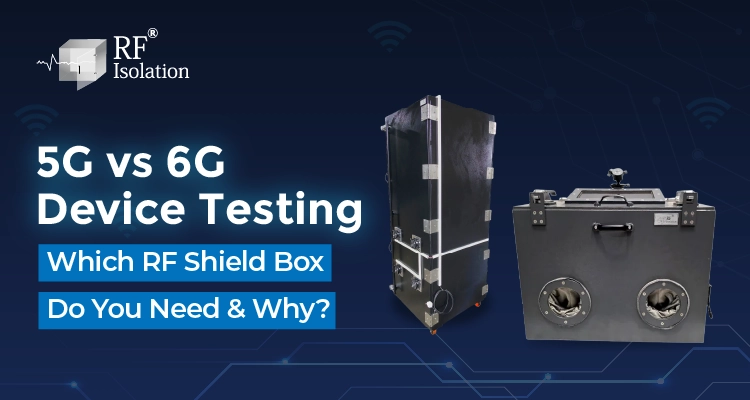
5G vs 6G Device Testing: Which RF Shield Box Do You Need & Why?
If you’re testing wireless devices in 2026, the frequency bands your device operates on will determine everything about your test setup – including the type of RF shield box you need. Whether you’re validating a 5G mmWave module or preparing for next generation 6G prototypes operating in the terahertz range, using the wrong shielding enclosure can invalidate your results entirely.
At RF Isolation, we work with RF engineers, telecom manufacturers, and R&D labs across the globe to help them choose the right testing environment for their specific wireless frequency requirements. This guide breaks down exactly what separates 5G and 6G device testing, and which RF shield box specifications matter most for each.
Not sure which RF shield box fits your current testing requirements?Talk to our experts at RF Isolation before investing in the wrong setup.
Key Takeaways
- 5G Testing Frequencies: 5G operates across sub-6 GHz and mmWave bands (up to 52.6 GHz), requiring shield boxes with high shielding effectiveness in those ranges.
- 6G Testing Frequencies: 6G is expected to operate in terahertz (THz) bands (100 GHz to 10 THz), demanding significantly more advanced RF isolation enclosures.
- Shielding Effectiveness Matters: For 5G mmWave, you need 80–100 dB attenuation; for 6G THz signals, requirements may exceed 100 dB across much higher frequency ranges.
- OTA Testing Is Critical: Both 5G and 6G require over-the-air (OTA) testing setups, but 6G OTA configurations are far more complex due to antenna array sizes and beam sensitivity.
- Material Differences Are Real: Shield boxes for 6G testing require more advanced materials and tighter mechanical tolerances to prevent signal leakage at sub-millimeter wavelengths.
- Not All Shield Boxes Are Equal: A desktop RF shield box suitable for sub-6 GHz 5G testing will not perform adequately for mmWave 5G or 6G terahertz device validation.
- Early 6G Preparation Pays Off: Labs investing in modular, upgradeable RF test enclosures now will be better positioned to handle 6G device validation without replacing their entire setup.
- Standalone vs. Rack Mount Matters: The choice between standalone, desktop, and rack mount RF shield boxes depends on throughput volume, frequency range, and whether your testing is R&D-focused or production-line oriented.
What Is the Core Difference Between 5G and 6G Device Testing?
The fundamental difference between 5G and 6G device testing comes down to frequency range, signal behavior, and the level of RF isolation required to get reliable results.
5G testing spans two major frequency categories: sub-6 GHz bands (FR1) and millimeter wave bands (FR2), ranging from 24 GHz up to 52.6 GHz. These signals are well understood, and the test equipment ecosystem around them is mature and widely available.
6G, currently in the research and standardization phase, is expected to operate in bands from 100 GHz to as high as 10 THz. At these frequencies, signal behavior changes dramatically. Wavelengths shrink to sub-millimeter sizes, and even minor gaps in a shielding enclosure can cause significant signal leakage or interference.
This means your RF shield box for 6G testing needs to meet far tighter tolerances than anything required for 5G validation today.
What RF Shield Box Specifications Does 5G Testing Require?
For 5G device testing, your shield box needs to perform reliably across a wide frequency range. Sub-6 GHz 5G devices are relatively easier to shield, but mmWave 5G is where most testing teams run into challenges.
Key specifications for 5G RF shield boxes include:
- Shielding effectiveness of at least 80 dB across the 600 MHz to 6 GHz range for FR1 devices
- 80 to 100 dB attenuation across 24 GHz to 52.6 GHz for mmWave FR2 devices
- Low-loss RF connectors and feedthroughs rated for mmWave frequencies
- Support for OTA (over-the-air) testing configurations with internal antenna fixture compatibility
- Minimal internal reflections to avoid measurement distortion during antenna performance testing
An RF Desktop Shield Box works well for lower-volume R&D and lab testing of 5G sub-6 GHz devices. For higher-frequency mmWave testing or production-line validation, an RF Standalone Shield Box or Rack Mount RF Shield Box offers better structural integrity and consistent shielding performance.
Ready to configure a 5G-ready test enclosure for your lab? Explore RF Isolation’s 5G device testing solutions here.
What Makes 6G RF Shield Box Requirements Different?
6G RF testing is in a different league entirely. When you move into terahertz frequency ranges, the physics of signal propagation and containment change in ways that require completely rethought enclosure designs.
Here is what 6G shield box testing demands that 5G setups do not:
- Shielding effectiveness ratings that hold up above 100 GHz, often requiring 100 dB or more
- Extremely tight mechanical tolerances on all seams, joints, and access doors to prevent leakage at sub-millimeter wavelengths
- Advanced absorber materials inside the chamber that can handle THz-range signals without reflection artifacts
- Precision-engineered RF feedthrough panels that do not degrade signal integrity at high frequencies
- Larger internal volumes in some configurations to accommodate complex multi-antenna arrays used in 6G MIMO and beamforming research
The challenge is that commercial 6G testing infrastructure is still maturing. Most labs working on 6G prototypes today are using custom-configured RF Chambers or modified high-frequency enclosures alongside specialized measurement instruments to build their test environments piece by piece.
5G vs 6G RF Shield Box: Direct Comparison Table
| Feature | 5G Shield Box | 6G Shield Box |
|---|---|---|
| Frequency Range | 600 MHz to 52.6 GHz | 100 GHz to 10 THz |
| Shielding Effectiveness | 80 to 100 dB | 100 dB+ (at THz bands) |
| Mechanical Tolerances | Standard | Ultra-tight (sub-mm wavelength) |
| Internal Absorber Material | Standard RF absorbers | High-frequency THz absorbers |
| OTA Testing Support | Yes (FR1 and FR2) | Yes (more complex arrays) |
| Connector/Feedthrough Type | SMA, 2.92 mm, 1.85 mm | WR connectors, custom THz interfaces |
| Commercial Availability | Widely available | Limited, custom-configured |
| Typical Use Case | Production testing, R&D | R&D, prototype validation |
Which Type of RF Shield Box Should You Choose for 5G Testing?
The right enclosure type for 5G testing depends on your testing volume, device category, and whether you are doing R&D or production-line validation.
RF Desktop Shield Box: Best for low-volume, lab-based 5G sub-6 GHz device testing. Compact, easy to use, and sufficient for engineers who need quick pass/fail isolation testing.
RF Standalone Shield Box: A stronger choice for mmWave 5G testing or when you need consistent, repeatable results across higher frequency bands. Better structural shielding and more customization options.
Rack Mount RF Shield Box: Ideal for production-line or high-throughput 5G device testing environments where multiple units need to be tested in sequence. Integrates well with automated test systems.
RF Test Rack: For labs running multiple simultaneous tests or validating several 5G device types, an RF Test Rack provides a scalable, organized testing infrastructure.
Looking to set up a production-ready 5G testing environment? Connect with our team at RF Isolation to get the right configuration.
How Should Labs Prepare for 6G Device Testing Today?
Even though 6G is still in the standardization and research phase, forward-thinking labs are already investing in infrastructure that will scale into 6G testing without a complete rebuild.
The smartest approach is to invest in modular RF Chambers and configurable enclosures now. Choosing shield boxes with upgradeable feedthrough panels, replaceable absorber materials, and modular internal fixtures means your lab can adapt as 6G testing standards evolve.
Labs should also pay close attention to the RF shielded door and panel construction quality in any enclosure they purchase today. Poor seam integrity that passes at 5G frequencies will fail badly at 6G terahertz bands.
According to the International Telecommunication Union (ITU), 6G is targeted for commercial deployment around 2030, which means labs have roughly four years to build testing competency and infrastructure. That timeline is shorter than it sounds when you factor in procurement cycles and lab validation.
5G vs 6G Testing Environment Comparison Table
| Testing Parameter | 5G Environment | 6G Environment |
|---|---|---|
| Primary Standard Bodies | 3GPP, ETSI, IANA | ITU-R, IEEE (in development) |
| OTA Test Method | Direct Far-Field, CATR | Advanced CATR, THz near-field |
| Antenna Configuration | MIMO, Massive MIMO | Ultra-Massive MIMO |
| Path Loss Behavior | Moderate at mmWave | Very high at THz (requires close-range testing) |
| Device Categories Tested | Phones, CPE, IoT modules | Next-gen radios, smart surfaces |
| EMI Shielding Challenge | High at FR2 | Extreme at THz bands |
| Test Automation Readiness | Mature ecosystem | Early-stage toolchains |
What Are the Biggest Challenges in 6G Terahertz Testing?
6G terahertz testing introduces challenges that do not exist at 5G frequencies, and engineers entering this space need to understand them clearly.
Signal attenuation is severe. THz signals lose power extremely fast over even short distances, which means test setups must be designed for close-range measurements with precise alignment.
Atmospheric absorption is significant. Water vapor and oxygen in the air absorb THz signals at specific frequencies, so some 6G test configurations may eventually require controlled-atmosphere chambers.
Component availability is limited. THz-rated connectors, cables, and feedthroughs are not yet mass-produced, which makes building 6G-ready shield boxes more of a custom engineering exercise than an off-the-shelf purchase.
Measurement accuracy is harder to achieve. At sub-millimeter wavelengths, tiny positional errors in antenna or device placement inside the enclosure can introduce significant measurement uncertainty.
These challenges make working with an experienced RF shielding partner essential, rather than optional.
Preparing for 6G prototype testing in your lab? Our team at RF Isolation can help you configure the right high-frequency test enclosure.
What Role Does EMI Shielding Play in Both 5G and 6G Testing?
Electromagnetic compatibility (EMC) testing and EMI shielding are non-negotiable in both 5G and 6G device validation. Without proper isolation, external signals contaminate your measurements, and your device’s own emissions can interfere with surrounding equipment.
For 5G devices, EMI shielding requirements are well-defined under standards from bodies like the FCC, CE, and ETSI. A properly rated RF shield box ensures your device operates in a clean electromagnetic environment during all phases of testing.
For 6G, while formal EMC standards are still being developed, early-stage research and prototype testing still requires robust EMI shielding to get meaningful data. Any signal bleed at THz frequencies, whether from external sources or internal reflections, will make test results unreliable.
This is why the construction quality of an RF shielded door, panel sealing, and internal absorber configuration inside an RF Chamber matters as much as the raw shielding effectiveness rating on a datasheet.
Conclusion: Choosing the Right RF Shield Box Starts with Knowing Your Frequency
The decision between a 5G and 6G RF shield box is not about brand preference or budget alone. It is about matching your enclosure’s shielding effectiveness, mechanical precision, and internal configuration to the actual frequency bands your devices operate on.
For 5G testing today, solutions like the RF Standalone Shield Box, RF Desktop Shield Box, and Rack Mount RF Shield Box from RF Isolation offer reliable, well-tested performance across both sub-6 GHz and mmWave bands. For labs beginning to explore 6G prototype testing, the right foundation is an RF Chamber or modular enclosure designed to be upgraded as terahertz testing standards mature.
RF Isolation is an India-based RF shielding solutions provider serving engineering teams and manufacturers across the globe. From individual desktop enclosures to full RF test racks and custom chambers, our team builds solutions around your actual testing requirements, not generic specs. Reach out to our team today to discuss which RF shield box is the right fit for your 5G or 6G device testing environment.
Frequently Asked Questions
A 5G RF shield box is designed to provide high shielding effectiveness across frequencies up to 52.6 GHz. A 6G RF shield box must perform reliably above 100 GHz into the terahertz range, requiring tighter tolerances, advanced materials, and more precise construction throughout.
In most cases, no. Shield boxes designed for 5G mmWave testing (up to ~52 GHz) will not maintain their shielding effectiveness at 100 GHz and above. 6G terahertz frequencies demand enclosures with specifically engineered seams, absorbers, and feedthroughs.
For 5G mmWave (FR2) device testing, a shielding effectiveness of 80 to 100 dB across the 24 GHz to 52.6 GHz range is generally required to ensure clean, isolated test results.
OTA (over-the-air) testing validates how a wireless device performs with its antenna integrated, without physical cable connections. Both 5G and 6G devices rely heavily on OTA testing because their antenna arrays are designed for beamforming, and cable-based testing cannot replicate real-world signal behavior.
A Rack Mount RF Shield Box or RF Test Rack is the most efficient choice for high-volume production-line 5G device testing, offering scalability, structural stability, and easy integration with automated test systems.
Based on ITU-R roadmap projections, 6G is targeted for commercial rollout around 2030. Meaningful 6G device testing at scale will likely become common in well-funded R&D labs between 2027 and 2029.
Yes. RF Isolation works with R&D teams and manufacturers to design and configure RF shield boxes, RF Chambers, and test enclosures for specific frequency requirements, including mmWave and early-stage THz applications.
A 6G RF shield box should use absorber materials specifically rated for high-frequency THz operation. Standard foam absorbers used in lower-frequency enclosures are often ineffective above 100 GHz and need to be replaced with materials designed for terahertz wavelengths.