Menu
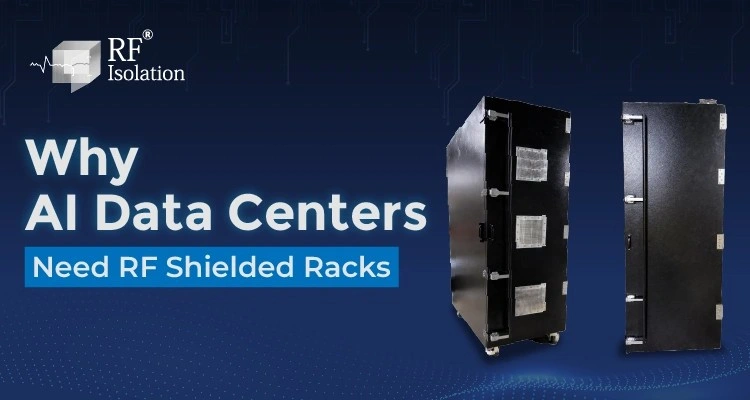
Why AI Data Centers Need RF Shielded Racks
AI data centers are not just rooms full of servers. They are dense, high-frequency computing environments running GPU clusters, AI accelerators, and terabit-scale networking all packed into shrinking physical footprints.
The problem? All of that hardware both radiates and is sensitive to electromagnetic interference (EMI). And as wireless infrastructure for 5G small cells, Wi-Fi 6E, industrial RF sources proliferate inside and around data centers. The risk of RF interference disrupting AI workloads has never been higher.
The solution is not better cables or thicker walls. It is RF Shielded Racks purpose-built enclosures that protect AI hardware from electromagnetic threats at the source.
What Is Electromagnetic Interference - and Why Does It Hit AI Hardware So Hard?
Electromagnetic interference (EMI) refers to unwanted electrical noise generated by electronic devices, wireless signals, power lines, or external RF sources. Every operating circuit produces some level of EM emissions, and every sensitive circuit is potentially vulnerable to them.
AI servers are uniquely susceptible for several reasons:
- They run GPUs and TPUs at extremely high clock frequencies often 1–3 GHz and beyond
- High-speed interconnects like NV Link, PCIe Gen5, and InfiniBand operate at frequencies prone to RF coupling
- AI workloads demand bit-perfect data integrity even minor bit errors cause model corruption or costly retraining
- Dense rack configurations create tight RF proximity, amplifying inter-device interference
In short: the faster and denser your AI compute becomes, the more vulnerable it is to RF interference, and standard server racks offer zero protection against it.
How Bad Is RF Interference in Modern AI Data Centers?
The scale of the problem is significant. AI data centers are increasingly co-located with 5G infrastructure, deployed in industrial campuses surrounded by heavy machinery, and packed with hundreds of rack units per facility. Each scenario introduces RF contamination across multiple frequency bands simultaneously.
Here is what RF interference does inside an AI data center:
- Memory errors in high-bandwidth GPU RAM (HBM2e, HBM3) causing silent data corruption
- NIC packet loss and increased retransmission rates, slowing distributed AI training jobs
- False triggering of protection circuits, causing unexpected server shutdowns mid-workload
- Clock jitter induced by RF coupling, degrading high-speed serial communication accuracy
- Increased thermal load from hardware operating under interference-induced stress
Real-world signal: A 2024 incident at a major hyperscaler linked unexplained GPU memory error spikes directly to nearby 5G small cell deployments in a textbook case of RF interference in AI compute infrastructure that cost weeks of retraining time.
What Is an RF Shielded Rack - and How Does It Work?
An RF Shielded Rack also called a shielded server rack, EMI shielded cabinet for servers, or RF shielded enclosure is a specialized enclosure that attenuates electromagnetic energy both entering and leaving the rack. It works by encasing rack-mounted hardware in a continuous conductive shell, forming what engineers call a Faraday cage.
The key components of an effective RF shielded rack include:
- Conductive enclosure panels – steel or aluminum with RF gaskets on every seam and opening
- RF shielded doors – with finger-stock or mesh gaskets maintaining 360° conductivity
- Cable penetration management – filtered cable entries to prevent signal leakage through I/O paths
- Ventilation with EMI filtering – honeycomb mesh vents that allow airflow while blocking RF
- Robust grounding system – chassis grounding to direct interference safely away from sensitive components
The result is a rack that delivers 40 dB to 100+ dB of shielding effectiveness across relevant frequency ranges from kHz-level power noise all the way to GHz-band 5G and mmWave signals.
Why Is 2026 the Inflection Point for RF Shielded Racks in AI Infrastructure?
Three converging trends make RF shielding in AI data centers not just beneficial – but critical infrastructure right now.
1. 5G and Early 6G Network Densification
Telecom operators are deploying massive numbers of 5G small cells and beginning early 6G infrastructure trials in urban and industrial zones. Many of these cells are mounted on or adjacent to commercial buildings, including data center facilities. The resulting RF environment at 3.5 GHz, 26 GHz, and mm Wave bands creates new interference threats that standard rack designs were never built to handle.
2. Ultra-Dense AI Compute Packing
GPU rack density in AI data centers has exploded. NVIDIA H100 and H200 clusters, AMD MI300X systems, and custom AI ASICs are being packed at 30–80 kW per rack. At those densities, devices are separated by centimeters, and RF coupling between components at such distances is significant and measurable.
3. AI Workloads Demand Zero-Error Compute
Large language models, multimodal AI systems, and autonomous AI cannot tolerate silent data corruption. A single bit of flip in a model of weight during training can propagate errors across the entire model. Unlike traditional IT workloads where errors are caught and retried cheaply, AI training runs that last week make hardware-induced data corruption catastrophically expensive to recover from.
RF Shielded Rack vs. Standard Server Rack: A Direct Comparison
| Feature | Standard Server Rack | RF Shielded Rack |
|---|---|---|
| EMI Protection | None / minimal | Military-grade (up to 100 dB) |
| RF Signal Containment | No containment | Full RF containment, no leakage |
| AI/GPU Hardware Safety | Vulnerable to interference | Fully protected across all bands |
| Compliance Support | Basic electrical safety | MIL-STD-461, IEC 61000, FCC Part 15 |
| Data Integrity | At risk from EM noise | Consistent, error-free data transfer |
| Wireless Crosstalk Risk | High in dense AI racks | Eliminated with proper shielding |
| Thermal Management | Standard airflow | Integrated shielding + airflow design |
| Suitable for 5G/6G Testing | No | Yes – purpose-built |
| Long-term Cost Efficiency | Lower upfront, higher failure risk | Higher upfront, lower downtime cost |
For AI data center operators, procurement managers, and RF engineers evaluating infrastructure investments, this comparison makes the case clear: RF shielded racks are not a luxury – they are a technical requirement for mission-critical AI deployments.
What Types of RF Shielded Enclosures Are Available for AI Data Centers?
Not all shielding solutions are the same. Depending on your use of case high-density GPU compute, wireless device testing, or sensitive signal analysis, different RF shielded products serve different purposes.
- Rack Mount RF Shield Box – The workhorse for AI data centers. Integrates directly into standard 19-inch rack systems, providing modular EMI protection without requiring full rack replacement. Ideal for isolating specific sensitive components like high-speed NICs or AI inference accelerators.
- RF Test Rack – Designed for environments where AI compute sits alongside wireless device testing increasingly common in automotive AI labs, aerospace research facilities, and 5G/6G R&D centers. Provides full rack-level shielding with integrated test access ports.
- RF Standalone Shield Box – For isolating individual devices or modules from ambient RF. Used in pre-compliance testing, device characterization, and scenarios where AI edge hardware must be validated against interference before deployment.
- RF Desktop Shield Box – Ideal for R&D teams needing quick isolation of test devices on a workbench without full rack infrastructure. Perfect for testing AI chips, SoCs, and wireless modules during early development.
- RF Chambers – Full anechoic or semi-anechoic chambers for comprehensive electromagnetic isolation. Used in aerospace, defense AI, and advanced wireless testing where complete RF isolation is required for accurate results.
How Do RF Shielded Racks Improve AI Computing Performance?
Beyond protection, RF shielded racks deliver tangible, measurable performance improvements in AI compute environments:
- Reduced memory error rates – fewer ECC corrections and zero silent bit flips in GPU HBM RAM
- Improved NIC throughput – lower retransmission overhead in InfiniBand and Ethernet AI fabric
- Stable clock synchronization – Precision Time Protocol (PTP) accuracy improves in RF-quiet environments
- Longer hardware lifecycle – components stressed by EMI fail faster; shielding extends MTBF significantly
- Regulatory compliance – defense AI, medical AI, and aerospace workloads must meet stringent EMC standards; shielded racks make compliance straightforward
These are not theoretical benefits. They translate directly into fewer unplanned outages, faster AI training throughput, and lower total cost of ownership over the datacenter lifecycle.
Which Industries Need RF Shielded Racks for AI Infrastructure Most Urgently?
- Aerospace & Defense AI: MIL-STD-461 compliance is non-negotiable. Defense AI systems from autonomous targeting to signal intelligence processing must operate with zero EMI vulnerability under all conditions.
- Automotive Electronics & Autonomous Vehicle AI: Automotive AI development labs run extensive RF testing alongside high-performance computers. Without shielding, interference between test environments and compute racks produces unreliable test results and delayed development cycles.
- Telecom & 5G/6G R&D: Telecoms building next-generation network AI needs both compute performance and RF-clean test environments. RF shielded racks serve double duty here protecting AI compute while enabling RF device validation in the same facility.
- University Research Labs & Testing Laboratories: Academic institutions running AI research alongside RF experimentation from antenna design to IoT protocol development need infrastructure that separates RF experiments from compute dependencies.
- Consumer Electronics & IoT AI Development: Product teams training AI models for consumer devices must validate hardware in realistic RF environments, while keeping their compute infrastructure isolated from the RF signals; they are actively generating.
What Standards Should RF Shielded Racks for AI Data Centers Meet?
When evaluating RF shielded server racks, look for compliance with:
- MIL-STD-461G: US military EMC standard; the gold standard for shielding performance verification
- IEC 61000-4 series: International electrotechnical commission EMC immunity requirements
- IEEE 299: Standard method of measuring the effectiveness of electromagnetic shielding enclosures
- FCC Part 15: US commercial RF emissions limits, critical for commercial AI data center deployments
- CISPR 32: Multimedia equipment EMC emissions standard, relevant for AI computer hardware
How Do You Choose the Right RF Shielded Rack for Your AI Data Center?
Selecting the right shielding solution requires evaluating five key parameters:
- Required attenuation level – based on your RF threat environment (5G bands, Wi-Fi 6E, industrial EMI)
- Frequency range coverage – shielding effectiveness must cover your specific interference frequencies (1 MHz to 40 GHz for modern deployments)
- Rack density and thermal requirements – shielding must not compromise cooling for high-TDP AI hardware
- Physical form factor – standard 19-inch EIA compliance, depth, height, and weight considerations
- Cable and fiber management – filtered entry points must accommodate your specific cabling and fiber infrastructure
RF Isolation’s engineering team works directly with AI infrastructure planners, RF engineers, and procurement managers to specify the exact solution whether a Rack Mount RF Shield Box, a full RF Test Rack, or a custom-engineered shielded enclosure for unique requirements.
Conclusion: RF Shielding Is No Longer Optional for AI Data Centers
The AI compute boom of 2025–2026 has fundamentally changed the electromagnetic environment inside and around data centers. Higher GPU densities, accelerating 5G densification, and zero-tolerance AI workloads have combined to make RF interference a mission-critical threat, not a minor nuisance to be ignored at procurement time.
RF Shielded Racks are the engineering answer to this challenge. They protect GPU clusters from electromagnetic contamination, ensure data integrity across AI training and inference workloads, and enable compliance with the regulatory standards that defense, aerospace, and medical AI operators must meet.
RF Isolation brings deep expertise in RF shielding technology to AI data center infrastructure from Rack Mount RF Shield Boxes to full RF Test Racks and RF Chambers. Whether you are an RF engineer specifying EMI solutions for a new facility, a procurement manager evaluating shielded server cabinets, or an R&D team testing the next generation of 5G and 6G devices alongside your AI compute stack, RF Isolation has the shielding solution engineered for your environment.
Frequently Asked Questions
An RF Shielded Rack is a server enclosure that blocks electromagnetic interference (EMI) using conductive shielding materials. It protects GPU clusters, AI accelerators, and networking hardware from RF noise that causes data corruption and hardware failure.
RF Shielded Racks deliver 40 dB to 100+ dB of shielding effectiveness depending on design and frequency range. For most AI data centers, 60–80 dB is sufficient to block 5G, Wi-Fi, and industrial RF threats.
They are strongly recommended for AI data centers near 5G infrastructure, running sensitive GPU workloads, or requiring EMC compliance. If data integrity and uptime are critical, RF shielding is essential, not optional.
Yes – RF Isolation’s shielded racks are purpose-built for 5G and 6G device testing, isolating test devices from ambient RF noise. This ensures accurate, repeatable measurements in both R&D and production environments.
Quality RF shielded racks comply with MIL-STD-461, IEC 61000, IEEE 299, FCC Part 15, and CISPR 32. Always request independent test reports to verify shielding performance at your specific frequency bands.