Menu
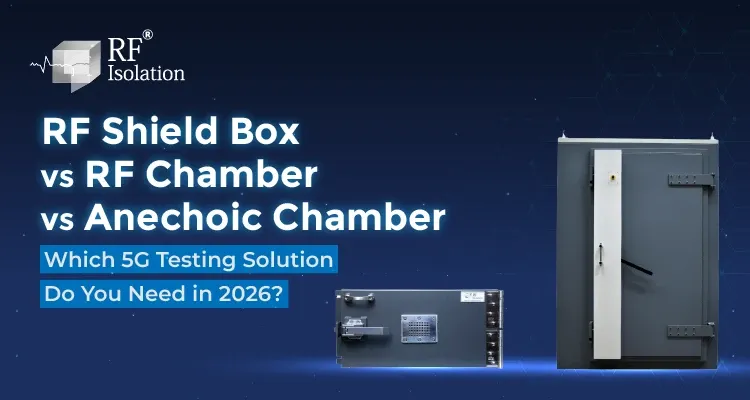
RF Shield Box vs RF Chamber vs Anechoic Chamber: Which 5G Testing Solution Do You Need in 2026?
If you’re testing 5G devices in 2026, your choice depends on three factors: testing scale, frequency range, and budget. RF shield boxes work best for desktop pre-compliance testing and small device validation. RF chambers suit mid-scale production testing and certification prep. Anechoic chambers are essential for OTA performance testing and 6G research. Each solution serves different stages of your 5G development cycle.
As 5G networks mature and 6G development expands, choosing the right RF isolation solution isn’t just about blocking interference anymore. It’s about matching your testing environment to increasingly complex wireless protocols, mmWave frequencies, and stringent 3GPP Release 18 standards.
At RF Isolation, we’ve helped hundreds of engineers solve this exact challenge. This guide breaks down when each solution makes sense for your specific testing needs, budget, and timeline.
What's the Core Difference Between RF Shield Boxes, RF Chambers, and Anechoic Chambers?
Think of these three solutions as different levels of RF isolation, each designed for specific testing scenarios.
RF shield boxes are compact Faraday cages designed for benchtop testing. They provide excellent shielding effectiveness (typically 80-120 dB) in a small footprint, making them perfect for development labs and pre-compliance testing.
RF chambers are larger, walk-in or rack-mountable enclosures that offer more testing volume and better environmental control. They typically deliver 100-140 dB of RF signal attenuation across wider frequency ranges.
Anechoic chambers combine RF shielding with pyramidal foam absorbers to create reflection-free environments. They’re essential for over-the-air (OTA) testing where you need to measure actual wireless performance without multipath interference.
The key difference isn’t just size – it’s about what you’re measuring. Shield boxes are effective at conducted emission testing and signal leakage prevention. Chambers handle both conducted and radiated emission testing. Anechoic chambers specialize in accurate path loss measurement and antenna pattern analysis.
When Should You Choose an RF Shield Box for 5G Testing?
RF shield boxes shine during early-stage development and rapid iteration cycles. Here’s when they’re your best choice:
You’re doing component-level testing.
When you need to validate individual RF modules, chipsets, or circuit boards before integration, an RF Desktop Shield Box provides the isolation you need without occupying entire lab spaces. You can test sub-6 GHz frequencies and even some mmWave bands in a controlled environment.
Budget and space are priorities.
Not every team has $200,000+ for a full chamber installation. A quality RF shield box delivers professional-grade shielding effectiveness at a fraction of the cost, and you can place it right on your existing workbench.
You’re running pre-compliance checks.
Before sending devices to formal certification labs, an RF Standalone Shield Box helps you identify EMI/EMC issues early. This prevents costly failures during official testing and speeds up your time-to-market.
Quick setup matters.
Unlike chambers that require installation and room preparation, shield boxes are plug-and-play solutions. You get I/O filter interfaces for connecting test equipment while maintaining signal isolation.
RF Isolation offers various shield box configurations – from compact desktop models for R&D teams to larger standalone units for production quality checks. These solutions are particularly effective for 5G NR frequency testing in the development phase.
Why RF Chambers Work Better for Mid-Scale 5G NR Testing
As your testing needs to scale beyond benchtop validation, RF chambers become the practical choice. Here’s what makes them essential for serious 5G testing:
Whole-device testing capability.
You can test complete smartphones, IoT modules, or automotive telematics units in realistic operating conditions. A Rack Mount RF Shield Box or RF Test Rack accommodates multiple devices at a time, perfect for production testing.
Better ambient noise reduction.
Chambers provide superior isolation from external RF interference – critical when you’re testing sensitive 5G protocols that operate in crowded spectrum. You get consistent, repeatable results regardless of what’s happening outside the test environment.
Certification readiness.
Most compliance testing for FCC, CE, and other regulatory bodies requires chamber-level performance. Having this capability in-house dramatically reduces your dependency on external test labs and speeds up iteration cycles.
Temperature and environmental control.
Many RF Chambers integrate climate control systems, allowing you to test 5G performance across temperature ranges – essential for automotive and aerospace applications where devices must function from -40°C to +85°C.
The investment in a chamber pays off when you’re testing dozens of units weekly or need to validate wireless protocol performance across different conditions. For defense, automotive, and medical technology applications, this level of control isn’t optional.
When Is an Anechoic Chamber Your Best Choice for 5G/6G Development?
Anechoic chambers represent the gold standard for wireless performance testing. You need one when measurement accuracy trumps all other considerations:
OTA testing is non-negotiable.
If you’re developing 5G devices for carriers or validating antenna designs, you need a reflection-free environment. The pyramidal foam absorbers eliminate multipath effects, giving you true line-of-sight measurements of radiated power and sensitivity.
You’re working with mmWave test enclosures.
5G millimeter wave frequencies (24-52 GHz) behave differently than traditional cellular bands. An anechoic chamber for 5G eliminates reflections that would completely distort mmWave measurements. This is critical for testing beamforming, MIMO performance, and spatial multiplexing.
6G research is in your roadmap.
As 6G development tools evolve toward even higher frequencies (potentially 100+ GHz), you’ll need the precise measurement capabilities only anechoic chambers provide. Investing now future-proofs your test infrastructure.
Certification testing happens in-house.
Full compliance testing for CTIA, PTCRB, or GCF requires anechoic chamber measurements. Having this capability eliminates the constant back-and-forth with external labs, saving weeks per product cycle.
You’re measuring total radiated power (TRP) and total isotropic sensitivity (TIS).
These critical metrics require 3D pattern measurements across all angles -impossible without a properly designed anechoic environment with positioning systems.
RF Isolation designs anechoic chambers optimized for both current 5G testing solutions and emerging 6G requirements, ensuring your investment remains relevant as standards evolve.
RF Shield Box vs RF Chamber vs Anechoic Chamber: Direct Comparison
| Factor | RF Shield Box | RF Chamber | Anechoic Chamber |
|---|---|---|---|
| Typical Size | Desktop to 3ft³ | 6-200ft³ | 100-2000ft³ |
| Shielding Effectiveness | 80-120 dB | 100-140 dB | 90-130 dB + absorption |
| Best For | Component testing, pre-compliance | Production testing, full device validation | OTA testing, antenna characterization |
| Frequency Range | DC-40 GHz | DC-110 GHz | 600 MHz-110 GHz (typical) |
| Setup Time | Minutes | Days-weeks | Weeks-months |
| Typical Investment | $5K-50K | $50K-300K | $200K-2M+ |
| Testing Type | Conducted emissions, debug | Conducted & radiated emissions | Radiated performance, OTA |
| 5G Use Cases | Module testing, chipset validation | Device compliance, protocol testing | mmWave optimization, carrier certification |
| Space Required | Benchtop | Lab corner or dedicated room | Dedicated facility |
| Portability | High | Low | None |
| RF Absorption | No | Optional | Yes (pyramidal foam) |
| Multi-device Testing | Limited (1-2) | Good (5-20) | Limited (1-3) |
This comparison highlights why many advanced testing operations maintain all three solutions. Each serves distinct stages of the 5G device development and certification process.
How Do You Choose the Right Solution for Your 5G Testing Needs in 2026?
Match your solution to your current testing phase and future roadmap. Here’s a practical decision framework:
- Start with these questions: What are you testing – components, complete devices, or wireless performance? How many units need testing weekly? What’s your regulatory timeline? What frequencies are critical to your products?
- For early-stage R&D teams: Begin with an RF Desktop Shield Box for component validation and basic EMI testing. This gets you 80% of the value at 10% of the cost. As your products mature, you can add chamber capabilities.
- For production environments: A Rack Mount RF Shield Box or RF Test Rack system handles high-throughput testing. You’ll want enough volume to test complete assemblies with all antennas and connectors in place.
- For certification-focused operations: Invest in proper chambers or anechoic environments early. The cost of failed certification tests far exceeds the chamber investment. Consider that a single failed FCC test cycle can cost $50K+ in lab fees and delay your launch by months.
- For advanced wireless development: If you’re pushing 5G boundaries or developing 6G devices, anechoic chamber capabilities are mandatory. You can’t optimize beamforming or validate MIMO performance without proper OTA measurement environments.
- Budget-conscious approach: Many teams start with shield boxes for internal development, then use external labs for final certification. As testing volume increases, bringing chamber capabilities in-house becomes cost-effective within 12-18 months.
RF Isolation can help you build a phased testing infrastructure that grows with your needs—starting with essential capabilities and expanding as your product portfolio and testing requirements evolve.
What About Future Proofing Your RF Testing Investment?
The wireless landscape evolves faster than test equipment depreciates. Here’s how to ensure your 2026 investment remains relevant through 2030 and beyond:
- Frequency flexibility matters most: Choose solutions that handle current 5G bands (600 MHz to 52 GHz) but can extend into 6G territory (up to 110+ GHz). Many RF Chambers from RF Isolation are designed with future frequency expansion in mind.
- Modular design beats monolithic systems: Look for chambers where you can upgrade absorber materials, add positioning systems, or expand testing volume without complete replacement. This is particularly important as 6G device development tools mature.
- Software-defined testing capabilities: The best modern chambers integrate with automated test equipment and support software-defined test sequences. This matters because 3GPP Release 18 standards and beyond introduce increasingly complex test cases.
- Consider hybrid approaches: Some teams combine a smaller anechoic chamber for OTA testing with larger RF chambers for environmental stress testing. This gives you specialized capabilities without paying for oversized anechoic spaces.
- Plan for mmWave test enclosures: Even if you’re not testing mmWave today, 5G’s migration toward higher frequencies is inevitable. Ensure your chambers can accommodate the tighter tolerances and smaller wavelengths of 24+ GHz testing.
Making Your 5G Testing Decision in 2026
Choosing between an RF Shield Box, RF Chamber, and Anechoic Chamber comes down to one thing – where you are in your 5G testing journey.
Shield boxes for development. Chambers for compliance. Anechoic chambers for precision. Most serious testing operations eventually need all three.
No matter your stage, RF Isolation has the right solution to match your requirements and budget. From early-stage R&D to full production testing, our team helps you build a testing infrastructure that works today and scales for tomorrow.
Ready to get started? Explore RF Isolation’s Solutions or contact us for a free consultation.
Frequently Asked Questions
Yes, quality RF shield boxes can test mmWave frequencies up to 40-50 GHz for conducted measurements and basic radiated emissions. However, proper mmWave OTA testing requires anechoic chambers due to reflection control requirements at these high frequencies.
You need 80-100 dB of shielding effectiveness across your operating frequencies for most 5G testing. The key is maintaining consistent performance across your entire frequency range, not just peak values – especially in RF-dense environments.
Yes, if you’re in advanced wireless development. An anechoic chamber designed for current mmWave testing will support 6G research with minimal modifications, giving you a competitive edge as standards evolve through 2028-2030.
Partially. EMI/EMC testing uses RF chambers or shield boxes, while wireless performance testing requires anechoic chambers for accurate OTA measurements. Many facilities use hybrid approaches with RF chambers for compliance and anechoic chambers (in-house or external) for performance validation.
With 10+ units tested monthly at external labs ($5K-15K per device), an in-house chamber ($100K-300K) pays for itself within 12-24 months. Factor in faster iterations, unlimited testing during development, and IP protection for complete ROI calculation.