Menu
RF Shield Box for Wi-Fi Router & Access Point Testing: What Should Engineers Specify?
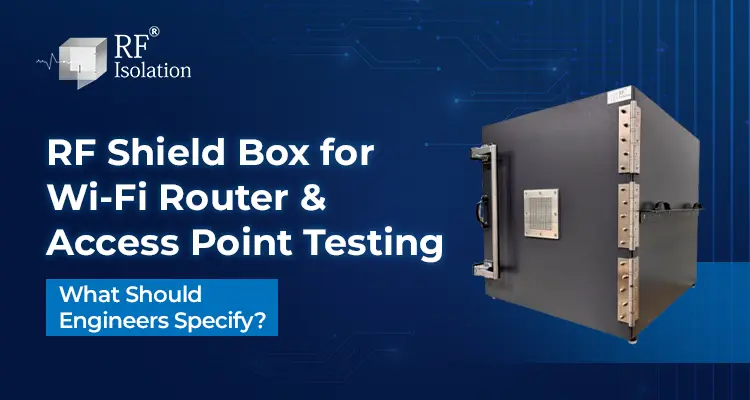
A shield box with strong isolation at 1 GHz can still be unsuitable for a Wi-Fi 6E router or access point. Shielding effectiveness changes with frequency, while the DUT may use 2.4 GHz, 5 GHz and 6 GHz radios together with Ethernet, PoE, power, control cables and multiple antennas.
For router and AP testing, engineers should specify the enclosure from the DUT outward: required Wi-Fi bands, isolation across those bands, internal volume, I/O, thermal load, absorber needs and the test workflow. Model figures in this article are specific to the named RF Isolation products and should not be treated as universal values.
Key Takeways
- Isolation is frequency-specific: Require measured shielding performance across every Wi-Fi band used by the DUT, not only at one headline frequency.
- 6 GHz requires extra checking: The 6 GHz Wi-Fi band extends above 6.0 GHz, so a box specified only up to 6 GHz may not cover every channel required by the product.
- Plan for the complete setup: Allow space for the router or AP, antennas, fixtures, cable bend radius and repeatable positioning.
- Treat every wall penetration carefully: Ethernet, PoE, power, USB and RF connections need an appropriate filtered, bonded or RF-compatible feedthrough design.
- Absorber is not shielding: Use absorber when reflections or multipath affect a radiated test; it does not replace the conductive RF barrier.
- Match the enclosure to the workflow: Desktop boxes suit bench validation, while rack-mount boxes and test racks fit structured or production-oriented systems.
Planning a router or access point test setup?
Share the DUT dimensions, enabled Wi-Fi bands, antenna layout and I/O requirements with RF Isolation before selecting an enclosure.
What Should Engineers Specify in an RF Shield Box for Wi-Fi Router Testing?
Start with the DUT and test method. The following checklist covers the specification points most likely to affect repeatability, integration and purchasing decisions.
| Specification | Why It Matters | What to Check |
|---|---|---|
| Isolation by frequency | Ambient RF can affect the DUT if enclosure isolation is weak at an active band. | Measured shielding effectiveness across all DUT bands and critical test frequencies |
| Internal volume | Antennas, fixtures and cables need space and repeatable geometry. | DUT size, antenna height, cable bend radius and clearance |
| I/O and feedthroughs | A poorly designed penetration can bypass the enclosure shield. | Ethernet rate, PoE, power, RF connectors and control lines |
| Absorber lining | Reflections and multipath can change compact radiated measurements. | Use when the test is sensitive to internal reflections |
| Ventilation | Powered routers and APs can heat a closed enclosure. | RF-compatible airflow and fan requirements |
| Mounting format | Access, automation and throughput determine integration needs. | Bench, 19-inch rack, production station and door access |
How Much RF Isolation Do Wi-Fi Routers and Access Points Need?
There is no universal dB value. Required isolation depends on ambient RF levels, the DUT’s receiver sensitivity, intended test signal level, measurement margin, frequency and leakage through interfaces. Specify isolation across every Wi-Fi band used by the DUT rather than relying on one value measured at 1 GHz or only at the highest frequency.
For 6 GHz testing, check the actual market and channel plan. In the United States, unlicensed 6 GHz operation extends from 5.925 to 7.125 GHz; India’s current framework covers 5925 to 6425 MHz for relevant low-power and very-low-power use cases. A datasheet that stops at 6.0 GHz therefore does not automatically demonstrate performance at 6.4 GHz or 7.1 GHz.
RF Isolation’s RF Desktop Shield Box range includes models such as RI 5639 and RI 5630-D specified up to 6 GHz. The RI 5550 standalone model is published from 20 MHz to 8 GHz. When required channels exceed a published limit, request measured shielding data at the actual frequencies you need.
How Large Should the Internal Volume Be?
Measure the full test arrangement, not only the router chassis. Include external antennas, fixtures, Ethernet and power connectors, cable bend radius and clearance needed to reproduce the same geometry between runs. Vertical antennas often make height the limiting dimension. If a standard box is too small, review the RF Standalone Shield Box range or a custom enclosure rather than compressing the setup into an undersized cavity.
Which I/O Does Router and Access Point Testing Require?
List every connection that crosses the shield boundary and define both its electrical function and data requirement. A router or AP may need WAN and LAN Ethernet, PoE, AC or DC power, USB or serial control, and conducted RF connections.
| Interface | Typical Use | RF / Integration Check |
|---|---|---|
| Filtered RJ-45 Ethernet | WAN, LAN and traffic-generator links | Confirm Ethernet rate; for PoE, verify the required power level and implementation as well as data speed. |
| AC/DC power filter | DUT power | Match voltage, current and power while preserving suitable RF attenuation on the line. |
| SMA/N-Type bulkhead | Conducted RF paths or test antennas | Use a well-bonded bulkhead and connectors rated for the highest test frequency. |
| Filtered USB/serial | Console, logging and control | Confirm interface type and data rate; filtering must suit the signal. |
| RF-compatible vent/fan | Cooling | Use honeycomb or another RF-compatible airflow structure rather than an unrestricted opening. |
| Fiber feedthrough | Optical data | Fiber avoids a conductive electrical path, but the physical aperture still needs RF-compatible sealing. |
For structured automation, RF Isolation’s Rack Mount RF Shield Box range can be configured around rack integration and user-defined I/O. Define PoE, Ethernet speed, RF connectors, control lines and cooling before the enclosure is built rather than adding uncontrolled cable paths later.
Need a custom I/O panel?
RF Isolation can review the router or AP interface list together with DUT size, frequency coverage and ventilation requirements.
Do Router and AP Tests Need RF Absorber Lining?
Not every test does. Absorber is useful when internal reflections, standing waves or multipath affect a radiated measurement or its repeatability. Conducted tests through RF cables depend more directly on enclosure isolation and the integrity of the RF, power and data interfaces.
In a compact box, small changes in DUT or antenna position can change coupling. Keep geometry fixed and characterize the RF path when performing quantitative work such as receiver-sensitivity or path-loss-dependent throughput measurements. A known-good router can help with station-to-station correlation, but it does not replace calibration or path characterization where the method requires it.
Desktop, Standalone, Rack Mount or RF Test Rack?
Choose by DUT size, access, automation and throughput rather than size alone.
- Desktop RF shield box: Best suited to bench R&D and lower-volume validation for small to mid-size routers or APs.
- Standalone shield box: Useful when the DUT, antennas or cable routing need more space and a flexible laboratory setup.
- Rack mount shield box: Fits structured 19-inch racks and automated stations where rear I/O and instrument integration matter.
- RF test rack: Supports larger production or R&D systems where internal volume, multiple test points or station integration drive the design. See RF Isolation’s RF Test Rack range for current configurations.
If several active routers or APs must be tested in parallel, one large shared cavity does not automatically isolate the DUTs from each other. Independent simultaneous wireless tests normally require separate shielded chambers or partitions, or another validated architecture that controls mutual interference and coupling. RF Isolation’s Wireless Device Testing solutions include multi- and twin-chamber approaches for parallel workflows.
How Do You Verify a Shield Box Before Buying?
Ask for shielding measurements at the frequencies relevant to the DUT and confirm how the enclosure was configured during the test. The I/O panel, vents, door and other penetrations can become limiting paths, so data from a bare enclosure may not represent the final system.
For high-isolation claims, ask about the measurement method, antenna arrangement, instrumentation, dynamic range, frequency points and I/O configuration. IEEE 299.1-2013 provides established procedures for smaller shielding enclosures, although IEEE currently lists that edition as Inactive-Reserved while a revision project is active. A simple open-versus-closed check can be useful for troubleshooting, but it should not replace documented shielding-effectiveness measurements when a specific dB value must be verified.
Why Discuss Router and AP Testing with RF Isolation?
RF Isolation manufactures desktop, standalone and rack-mount shield boxes and RF test racks in Ahmedabad, India. Current product pages describe customization around enclosure dimensions, I/O panels, absorber and rack integration, which is relevant when Wi-Fi band coverage, antenna geometry, Ethernet or PoE, ventilation and automation must be considered together.
For broader setup guidance, the existing Wi-Fi, Bluetooth and 5G device testing guide explains how isolation, DUT positioning and interface leakage affect repeatability across wireless test workflows.
Conclusion
A useful RF shield box specification for a Wi-Fi router or access point covers isolation across every enabled band, enough volume for the complete DUT setup, RF-compatible I/O matched to data and power requirements, appropriate thermal management, absorber only where reflection control is needed, and a form factor that fits the workflow. For 6 GHz products, verify the actual channels required in the target market rather than assuming a specification ending at 6.0 GHz covers the full band.
If you are specifying an enclosure for a router or AP program, RF Isolation can review the DUT dimensions, enabled bands, antenna arrangement, Ethernet or PoE requirements and production workflow before recommending a configuration. Talk to a Shielding Specialist.
Frequently Asked Questions
There is no single value. It depends on ambient RF, receiver sensitivity, intended signal level, measurement margin, frequency and interface leakage. Require measured isolation across all bands used by the DUT.
Yes, if the enclosure has suitable isolation across every enabled band and enough room for the DUT, antennas, fixtures and cables. For 6 GHz operation, confirm characterization above 6.0 GHz when the required channels extend higher.
Yes. Conductive interfaces can become RF coupling paths if their feedthrough design is unsuitable. Confirm Ethernet speed, PoE power requirements, power-filter ratings and shield termination during specification.
Not for every test. Use absorber when reflections, multipath or standing waves affect a radiated measurement or repeatability; it does not replace the conductive shield.
Yes, but independent simultaneous tests require sufficient isolation between active DUTs. Separate chambers or partitions are generally preferable to placing multiple transmitting devices in one shared cavity.
No. A shield box supports controlled development, validation and pre-compliance testing. Regulatory approval and Wi-Fi certification follow the applicable authority, accredited laboratory and certification process for the target market.