
✔ Isolation 100 dB or Higher as per IEEE-299
✔ Frequency Range 30 MHz to 18 GHz, Extendable up to 40 GHz
✔ Manual, Semi-Automatic and Hydraulic Door Options
✔ Single-Leaf and Double-Leaf Configurations
✔ Beryllium Copper Finger Stock and Tight Gasket System
✔ Optional Absorber Mounting and Powder-Coated Finish
✔ Ships Pan-India and Globally
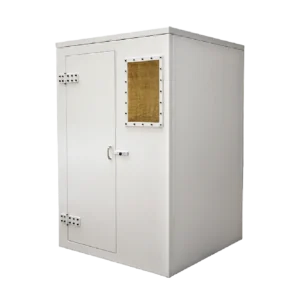
Every RF Isolation shielded door is designed for facilities where RF isolation, safety, mechanical reliability, and ease of operation matter together. Whether the door is used for a compact chamber, a large shielded room, or a full EMI/EMC test facility, it helps protect the RF environment without slowing down daily testing work.
| Feature | What It Means for You |
|---|---|
| 100 dB or Higher Isolation | Helps maintain high shielding performance by preventing outside RF noise from entering the test space and reducing unwanted signal leakage from inside the chamber. |
| 30 MHz to 18 GHz Frequency Range | Supports common RF, wireless, EMI/EMC, telecom, defence, and chamber testing applications. The design can be extended up to 40 GHz when required. |
| Manual, Semi-Automatic and Hydraulic Options | Choose the operating style that matches your chamber size, usage frequency, access needs, and operator workflow. |
| Tight Locking and Gasket System | Provides firm door closure and reliable RF sealing around the frame, helping preserve shielding effectiveness through repeated open and close cycles. |
| Beryllium Copper Finger Stocks | Low-pressure tin-plated beryllium copper contact strips provide consistent electrical contact between the door and frame for stable RF performance. |
| Single or Double Row Contact Design | Contact strip arrangement can be selected based on isolation requirement, door size, operating method, and frequency range. |
| Optional Absorber Mounting | Absorption material can be mounted on the door surface when the door is part of an anechoic or semi-anechoic chamber requiring reflection control. |
| Rugged Mechanical Construction | Heavy-duty structure supports long-term operation in labs, chamber rooms, industrial test facilities, and high-use access areas. |
| Powder-Coated Exterior Finish | The outside structure can be powder coated when required to improve appearance, durability, and integration with the chamber or room finish. |
| Custom Size and Site Fitment | RF Isolation can manufacture shielded doors around your wall opening, chamber design, panel system, access direction, and installation constraints. |












Verified Shielding Performance Before Handover
Custom-Built for Your Chamber and Site
ISO 9001:2015 Certified Manufacturing
Designed for Manual & Automated Access Needs
Trusted by Leading Technology Companies
Small to medium RF rooms, compact chambers, controlled access spaces, and teams that need simple operation with dependable sealing.
Labs with frequent operator access where smoother door handling and repeatable closure are important.
Larger chamber doors, heavy-duty openings, equipment entry, and high-isolation rooms that need strong, uniform closing pressure.
Standard chamber access and personnel entry where one door panel is sufficient.
Wide openings, equipment transfer, trolley movement, and larger DUT handling inside RF rooms or chambers.
Site-specific chamber rooms, retrofit projects, shielded wall systems, and custom RF facility upgrades.
The right RF shielded door depends on your chamber size, wall opening, isolation requirement, frequency range, operating method, access frequency, equipment movement, absorber requirement, and whether the facility is used for R&D, pre-compliance, production validation, or secure RF testing. Use this guide to select a suitable door configuration or contact our shielding specialists for a recommendation.
| Door Type | Best For |
|---|---|
| Manual RF Shielded Door | Best for smaller shielded rooms, compact RF chambers, low to medium usage areas, R&D labs, and facilities where simple, reliable operation is preferred. |
| Semi-Automatic RF Shielded Door | Suitable for regular chamber access where assisted operation improves usability without moving to a fully hydraulic system. |
| Hydraulic RF Shielded Door | Ideal for larger doors, high-use test facilities, heavy-duty chamber access, equipment movement, and installations where stronger closing pressure is required. |
| Single-Leaf RF Shielded Door | Suitable for standard personnel access, smaller equipment entry, and chamber rooms where one-sided opening provides enough clearance. |
| Double-Leaf RF Shielded Door | Best for wider openings, larger DUT movement, trolley access, equipment racks, and test facilities that need greater entry width. |
| Custom RF Shielded Door | Recommended when your wall opening, shielded panel system, absorber design, finish, contact layout, or site condition needs a project-specific door design. |
RF shielded doors are used in anechoic chambers to maintain chamber isolation while allowing operator access, equipment movement, antenna positioning, and absorber-lined internal layouts.
Semi-anechoic facilities need RF-tight access doors for radiated emissions, radiated immunity, and pre-compliance testing. A reliable shielded door helps protect the measurement environment.
Dedicated shielded rooms use RF shielded doors to control leakage at the main access point. This supports telecom validation, wireless testing, secure communication work, and sensitive RF measurements.
Telecom and wireless teams use shielded doors in test rooms for 4G, 5G, Wi-Fi, Bluetooth, IoT, and mmWave device validation where ambient RF control is important.
Antenna labs need low-interference access points for pattern measurement, gain testing, polarization checks, efficiency testing, and repeatable RF research.
Defence and aerospace teams use shielded rooms with RF-tight doors for secure communication testing, radar work, receiver testing, and sensitive electronics validation.
Automotive testing facilities use larger shielded doors where radar modules, vehicle parts, fixtures, and test equipment need to move inside controlled RF environments.
Production and QA teams use shielded rooms and chamber areas for repeatable RF checks, final validation, troubleshooting, and controlled device testing.
University and R&D labs use RF shielded doors in research chambers, experimental setups, propagation studies, and training environments.
Existing chambers often need door replacement or upgrade when sealing, contact wear, access needs, or shielding performance no longer meet testing requirements.

Build a reliable RF-tight access system for your chamber, shielded room, EMI/EMC facility, or wireless testing lab with a door customized to your opening, frequency range, operating method, and shielding requirement.
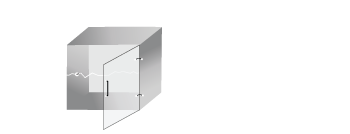
An RF Shielded Door is a specially engineered access door that maintains shielding integrity in RF chambers, EMI/EMC rooms and shielded test facilities. It uses conductive contacts, pressure-sealing mechanisms and an accurately aligned frame to limit RF leakage while allowing personnel, equipment and test devices to enter or exit.
An RF shielded door is used to provide RF-tight access to an RF chamber, anechoic chamber, EMI/EMC room, shielded room, or secure testing facility. It helps maintain shielding performance while allowing personnel and equipment movement.
A normal metal door can leave small gaps around the frame, hinge area, latch side, and floor. An RF shielded door uses conductive contact strips, finger stocks, gasket systems, and controlled pressure sealing to reduce RF leakage.
RF Isolation RF shielded doors can be designed for 100 dB or higher isolation as per IEEE-299, depending on frequency range, door size, contact arrangement, frame design, and site installation quality.
The standard design supports 30 MHz to 18 GHz, with options that can be extended up to 40 GHz based on the chamber design and project requirement.
RF Isolation can manufacture manual press, semi-automatic, and hydraulic RF shielded doors. The right option depends on door size, access frequency, opening width, and required closing pressure.
Yes. Door size, opening direction, frame design, contact layout, finish, absorber mounting, operating mechanism, and installation details can be customized for your site.
Yes. Provision for absorber mounting can be added when the door is used inside an anechoic or semi-anechoic chamber where reflection control is required.
Yes. Single-leaf doors are suitable for standard access, while double-leaf doors are useful for larger openings, equipment movement, trolley entry, and large DUT handling.
Yes. RF shielded doors are suitable for EMI/EMC rooms, pre-compliance facilities, shielded test rooms, and chamber projects where controlled RF isolation is required.
Inspect the contact strips, finger stocks, gasket areas, hinges, latches, locking system, and frame alignment regularly. Keep contact surfaces clean and avoid damage during equipment movement.

Please fill in your details to receive a call from our sales team about the right product for you.