Menu
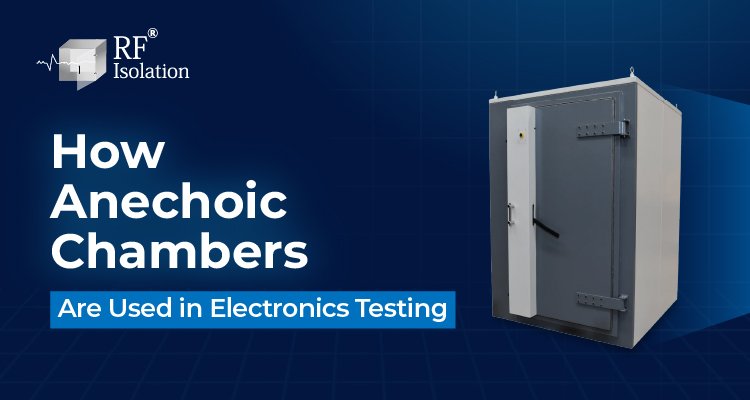
How Anechoic Chambers Are Used in Electronics Testing (Complete Guide)
If you are testing a wireless device, an antenna, or any electronics product that emits or receives electromagnetic signals, you need a controlled environment. That is exactly what an anechoic chamber provides. It eliminates unwanted reflections, external interference, and background noise so that your test results reflect real device performance, not environmental contamination.
For engineers and labs working in EMI EMC testing, 5G device testing, or antenna performance validation, anechoic chambers are not optional extras. They are the foundation of accurate, repeatable, and certifiable results. At RF Isolation, we help testing labs and electronics manufacturers find the right RF testing solutions for their specific requirements, whether that is a full RF anechoic chamber or a compact shielded test enclosure.
Key Takeways
- What is an anechoic chamber: An anechoic chamber is a specially designed room that absorbs electromagnetic or acoustic reflections, creating a controlled, interference-free environment for electronics testing.
- Primary use case: These chambers are used primarily for EMI EMC testing, antenna testing, OTA (over-the-air) testing, and wireless device testing across industries including telecom, aerospace, and automotive.
- RF vs. acoustic chambers: RF anechoic chambers absorb radio frequency signals using ferrite tiles or pyramidal foam absorbers, while acoustic chambers are lined with sound-absorbing wedges. Both serve different but equally important testing functions.
- Why it matters for compliance: Electronics products must pass EMC compliance testing before entering markets like the US, EU, and India. Anechoic chambers are often required to conduct these certified tests.
- 5G and IoT impact: The rollout of 5G and the growing IoT ecosystem have significantly increased demand for anechoic chamber testing, as devices must perform across multiple frequency bands without mutual interference.
- Key industries: Telecom, automotive electronics, aerospace and defense, semiconductor manufacturing, Wi-Fi and Bluetooth device makers, and mobile phone testing companies all rely on anechoic chamber testing.
- Choosing the right setup: Not every lab needs a full walk-in chamber. Compact RF chambers, RF shield boxes, and RF desktop shield boxes can serve specific testing needs at lower cost with high isolation performance.
- Accuracy advantage: Tests conducted inside anechoic chambers produce results that are not affected by external signals, making them 10 to 40 dB more accurate than tests conducted in open, uncontrolled environments.
What Is an Anechoic Chamber and How Does It Work?
An anechoic chamber is a room designed to completely absorb reflections of electromagnetic waves, sound waves, or both. The word “anechoic” literally means “without echo.”
In electronics testing, the goal is to simulate a free-space environment where signals from the device under test (DUT) travel in all directions without bouncing back. Any reflected signal that returns to the measurement antenna would distort the test data, leading to false readings.
The chamber achieves this by lining all interior surfaces, including walls, floor, and ceiling, with RF-absorbing materials. These materials are typically pyramidal polyurethane foam loaded with carbon, ferrite tiles, or a combination of both. Pyramidal absorbers work best at higher frequencies (above 1 GHz), while ferrite tiles perform better at lower frequencies (30 MHz to 1 GHz).
The entire chamber is also enclosed in a metallic shell, usually made of steel or galvanized iron, that provides RF shielding. This shell prevents external signals from Wi-Fi routers, mobile towers, radio stations, and other ambient sources from entering the test environment.
The result is a room that is electromagnetically quiet from the outside and reflection-free on the inside, which is exactly what you need for accurate antenna testing, EMI measurements, and wireless device testing.
What Are the Main Types of Anechoic Chambers Used in Electronics Testing?
Not all anechoic chambers are the same. Choosing the right type depends on the frequency range you are testing, the size of the device, and the specific measurement you need to perform.
RF Anechoic ChambersThese chambers are designed specifically for radio frequency testing. They are used to test antenna radiation patterns, measure radiated emissions, evaluate radiated immunity, and carry out over-the-air (OTA) testing for wireless devices.
RF anechoic chambers are typically used for frequencies ranging from 30 MHz to 40 GHz and beyond. The absorption performance of the lining material determines the lowest usable frequency of the chamber.
Semi-Anechoic ChambersA semi-anechoic chamber has absorbers on the walls and ceiling but not on the floor. A ground plane is placed on the floor instead. This design is standard for automotive electronics and large device EMC testing, as it simulates real-world conditions where the device sits on a reflective surface (like a car body or floor).
Full Anechoic ChambersA full anechoic chamber covers all six surfaces with absorbers. These chambers are used for precise antenna gain measurements, radar cross-section measurements, and satellite communication device testing where ground reflections must also be eliminated.
Compact Range ChambersThese use a reflector to convert a spherical wavefront into a planar wavefront, allowing far-field antenna measurements in a physically small room. They are used widely in aerospace and defense testing where large antennas and radar systems need to be evaluated.
Anechoic Chamber vs. Other Shielded Test Environments
| Feature | RF Anechoic Chamber | RF Shielded Chamber | RF Shield Box |
|---|---|---|---|
| RF Shielding | Yes (60-120 dB) | Yes (60-120 dB) (up to 100 dB) | Yes (80-110 dB) |
| Signal Absorption | Yes (no reflections) | No (reflections present) | Limited |
| Antenna Testing | Ideal | Not suitable | Not suitable |
| EMI Emissions Testing | Ideal | Good | For small devices only |
| OTA Testing | Ideal | Limited | Limited |
| Size of DUT | Large to very large | Medium to large | Small to medium |
| Cost | High | Medium | Low |
| Lab Space Required | Large | Medium | Compact |
This comparison shows that anechoic chambers are the right choice when the accuracy of radiated performance is the top priority. However, for connector-based RF testing, production line screening, or small device EMC compliance testing, RF shield boxes and RF chambers serve as highly practical and cost-effective alternatives.
If your lab is scaling up from device-level testing to full radiated testing, explore how RF shield boxes serve different stages of electronics testing workflows before committing to a full chamber setup.
Ready to choose the right RF testing environment for your lab? Talk to our team at RF Isolation to get a solution matched to your device type and budget.
What Is an Anechoic Chamber Used for in Electronics Testing?
This is the most important question engineers and procurement managers ask. Here is a complete breakdown of real-world applications.
1. EMI and EMC Testing
EMI EMC testing measures how much electromagnetic interference a device emits and how well it can tolerate interference from other sources. Both tests are required for regulatory certification in almost every country.
Regulatory bodies like the FCC (USA), CE (Europe), BIS (India), and VCCI (Japan) require that electronics products pass emissions and immunity tests before they can be sold. Anechoic chambers are the preferred environment for these tests because they prevent external signals from contaminating the measurements.
Inside the chamber, the device under test is placed on a turntable and rotated 360 degrees while a measurement antenna scans the emissions across the required frequency range. This gives engineers a full radiated emission profile of the product.
2. Antenna Radiation Pattern Testing
Every device with a wireless function, whether it is a smartphone, a Wi-Fi router, a radar module, or a satellite receiver, has an antenna. The radiation pattern of that antenna determines how well the device communicates.
In an anechoic chamber, engineers can map the complete 3D radiation pattern of an antenna without any interference from reflected signals or ambient RF energy. This is critical for device optimization, especially for products operating at 5G mmWave frequencies where beam steering accuracy must be validated.
3. OTA (Over-the-Air) Testing for Wireless Devices
OTA testing measures the real-world wireless performance of a complete device, including the antenna, RF front end, and baseband processing. Key metrics include total radiated power (TRP) and total isotropic sensitivity (TIS).
OTA testing inside an anechoic chamber is now a mandatory requirement for 5G device certification by organizations like CTIA, 3GPP, and GCF. Without a properly qualified anechoic chamber, a 5G smartphone, IoT sensor, or wireless module cannot receive network operator approval.
4. Radar Cross-Section (RCS) Measurement
Defense and aerospace companies use anechoic chambers to measure the radar cross-section of aircraft components, vehicles, and military hardware. RCS measurements require an environment completely free of reflections, making full anechoic chambers the only viable option.
5. Satellite and Microwave Device Testing
Devices operating at microwave frequencies, including satellite modems, VSAT antennas, and microwave point-to-point links, require anechoic chamber testing to verify gain, beam accuracy, and sidelobe performance.
6. Automotive Electronics Testing
Modern vehicles contain dozens of wireless modules: GPS, V2X communication, keyless entry, tire pressure sensors, and connected infotainment systems. All of these must be tested for EMC compliance and antenna performance, often in semi-anechoic chambers that simulate the ground plane condition of a vehicle chassis.
The blog post on RF shielding in automotive device testing provides a detailed look at how automotive electronics labs approach this challenge.
Your devices deserve test results you can trust. Explore RF Isolation’s range of RF chambers and testing enclosures built for precise EMI EMC and OTA testing.
How Does RF Absorption Work Inside an Anechoic Chamber?
The walls of an RF anechoic chamber are not just thick layers of foam. The design of the absorber material is precisely engineered to maximize energy absorption across the target frequency range.
Pyramidal foam absorbers work gradually transitioning from free space (air) to the absorbing medium. The tips of the pyramids represent a low-impedance transition point that matches the impedance of free space (377 ohms). As the signal travels deeper into the foam, it is progressively absorbed through resistive loss until almost no signal remains reflected back.
The deeper and denser the pyramid, the lower the frequency it can absorb effectively. A 300 mm deep pyramid can absorb frequencies above about 1 GHz. To absorb frequencies down to 30 MHz, pyramid depths of 1 meter or more are often needed, which is why large anechoic chambers can be several meters tall.
Ferrite tiles work differently. They absorb energy through magnetic loss mechanisms and are effective at lower frequencies where foam alone is insufficient. Most professional RF anechoic chambers use a hybrid approach: ferrite tiles on the inner metallic shell and pyramidal foam absorbers on top of them.
What Are the Key Performance Parameters of an Anechoic Chamber?
When evaluating or specifying an RF anechoic chamber for electronics testing, engineers focus on these critical parameters:
- Shielding effectiveness (SE): The ability of the outer metallic shell to block external signals, measured in decibels. A good chamber provides 60 to 120 dB of shielding across the test frequency range.
- Quiet zone reflectivity: The level of reflected signals within the defined measurement zone, also expressed in dB. Lower reflectivity means more accurate measurements.
- Usable frequency range: The lowest and highest frequencies at which the chamber delivers its rated performance, determined by the absorber design.
- Turntable capacity: The maximum weight and size of the DUT that the chamber can accommodate.
- Antenna mast range: The height range of the receive antenna, typically 1 to 4 meters for standard EMC measurements.
- Temperature and humidity control: Some chambers include climate control systems to allow testing under specific environmental conditions.
Anechoic Chamber Testing: Key Standards and Certifications
| Standard | Issuing Body | Application |
|---|---|---|
| CISPR 16 | IEC / CISPR | EMC measurement methods and apparatus |
| ANSI C63.4 | ANSI | EMC testing of unlicensed wireless devices (USA) |
| IEC 61000-4 Series | IEC | Immunity testing standards |
| 3GPP TS 38.521 | 3GPP | 5G NR OTA test requirements |
| MIL-STD-461 | US DoD | EMI requirements for military electronics |
| ETSI EN 301 489 | ETSI | EMC for radio equipment (Europe) |
| AMS-STD-RS 0107 | CTIA | OTA performance testing for wireless devices |
Who Needs an Anechoic Chamber for Electronics Testing?
Here are the industries and organizations that rely on RF anechoic chambers and EMC testing chambers as part of their quality and compliance processes:
- Telecom equipment manufacturers testing base stations, repeaters, and small cells
- 5G and IoT device manufacturers requiring OTA certification before market launch
- Smartphone and mobile device makers validating antenna performance across frequency bands
- Wi-Fi and Bluetooth device manufacturers testing radiated emissions and receiver sensitivity
- Aerospace and defense companies evaluating avionics, radar, and communication systems
- Automotive OEMs and tier-1 suppliers testing connected vehicle modules
- Semiconductor companies measuring the radiated performance of RF chipsets
- Research institutions and universities conducting wireless communication research
- Contract EMC testing labs offering third-party compliance certification services
For labs that handle high volumes of small wireless devices and need to complement full chamber testing with bench-level screening, solutions like RF standalone shield boxes and RF desktop shield boxes from RF Isolation provide an efficient and cost-effective first-pass testing option.
Need a compact, high-isolation shielded enclosure to complement your EMC testing workflow? Visit RF Isolation to see the full range of RF testing solutions.
What Are the Challenges in Anechoic Chamber Testing?
Even in a well-designed chamber, engineers face practical challenges that require careful attention.
- Ambient signal leakage: Even small gaps in the shielding shell can allow external signals to enter. Cable penetrations, ventilation ducts, and door seals must all be carefully designed and maintained to preserve shielding performance.
- Low-frequency limitations: At frequencies below 30 MHz, the absorber depth required to achieve good performance becomes impractical. Engineers often use alternative methods, such as shielded rooms with ground planes, for very low-frequency testing.
- Large DUT handling: Testing a full aircraft or vehicle requires a very large chamber with specialized positioning equipment. Most labs working at this scale build custom facilities rather than using off-the-shelf chambers.
- Calibration and validation: A chamber must be validated before use and periodically re-validated to confirm performance. Validation involves measuring quiet zone reflectivity using reference antennas and comparing results against the design specification.
- Cost and space: A full walk-in RF anechoic chamber represents a significant capital investment and requires dedicated floor space. For organizations that cannot justify this investment, third-party EMI testing labs and compact RF shield boxes provide practical alternatives.
Anechoic Chambers vs. Open Area Test Sites (OATS): Which Is Better?
Historically, EMC testing was conducted at open area test sites, which are outdoor locations cleared of reflective objects where devices could be tested under sky conditions. OATS are still recognized by some regulatory standards, but they have significant limitations.
Weather conditions, ambient RF interference from Wi-Fi, cellular, and broadcast signals, and the variability of ground reflection make OATS results difficult to reproduce. Anechoic chambers solve all of these problems by creating a controlled, repeatable, and weather-independent testing environment.
Most modern EMC compliance testing is now done in accredited anechoic chambers, and standards bodies increasingly prefer chamber-based results because of their repeatability and resistance to external interference.
How RF Isolation Supports Your Anechoic and EMC Testing Needs
RF Isolation is India’s trusted source for RF shielding and testing solutions, serving global clients across telecom, aerospace, automotive, semiconductor, and IoT sectors. Our product range includes RF chambers, RF standalone shield boxes, RF desktop shield boxes, rack mount RF shield boxes, RF test racks, and RF shielded doors, all designed and built to meet the exacting demands of modern electronics testing.
Whether you are setting up a new EMI testing lab, upgrading your wireless device testing capabilities, or looking for compact shielded enclosures to handle production-line testing, our team has the expertise to guide you to the right solution.
We work with RF engineers, test lab managers, compliance teams, and procurement specialists to match the right product to the right application, so you never pay for more than you need, and you never compromise on performance.
Ready to upgrade your electronics testing setup? Get in touch with our team at RF Isolation and let us help you build a testing environment that delivers accurate, certifiable results every time.
Frequently Asked Questions
A Faraday cage blocks external electromagnetic signals from entering but does not absorb internal reflections. An anechoic chamber does both: it shields against external signals and absorbs internal reflections using RF-absorbing materials. For accurate radiated measurements, the absorption of internal reflections is essential.
Yes. Compact RF anechoic chambers and semi-anechoic chambers are available in sizes suitable for small to medium devices. For 5G sub-6 GHz devices, even compact chambers can provide the OTA testing environment needed for pre-compliance validation.
A professionally built RF anechoic chamber typically provides between 60 dB and 120 dB of shielding effectiveness across the relevant frequency range. The specific level depends on the construction materials, seam quality, and door design.
OTA (over-the-air) testing measures the actual wireless performance of a device including its antenna, RF electronics, and software together as a system. It requires an anechoic chamber because any reflected signals inside the test environment would distort the measurements of total radiated power (TRP) and total isotropic sensitivity (TIS).
No. While EMC compliance testing is one of the most common uses, anechoic chambers are also used for antenna pattern measurement, radar cross-section analysis, OTA testing, satellite device testing, microwave characterization, and acoustic measurements depending on the chamber type.
Most RF anechoic chambers are designed to operate from 30 MHz to 18 GHz or 40 GHz. Chambers using deeper absorbers combined with ferrite tiles can extend performance down to 30 MHz. Millimeter-wave chambers for 5G mmWave testing can operate up to 86 GHz and beyond.
Most accreditation standards and testing labs require annual re-validation of the chamber’s shielding effectiveness and quiet zone performance. Re-validation is also required after any modification, repair, or relocation of the chamber.
An RF shield box is ideal for connector-based testing, production-line screening, and pre-compliance testing of small wireless devices. For full radiated EMC compliance testing and OTA measurements, a full anechoic chamber is required. Many labs use both: shield boxes for early-stage testing and anechoic chambers for final certification.