Menu
Top 10 Applications of RF Shielded Enclosures in Wireless Device Testing
In today’s connected world, our air is filled with invisible signals from Wi-Fi, 5G, and Bluetooth. For engineers testing a new wireless product, this “signal explosion” is a major problem.
How can you know if your test results are accurate? Is a product failure real, or just interference from the building’s Wi-Fi?
The answer is to filter out all that noise. This is exactly what an RF shielded enclosure does.
At RFIsolation, we build these “quiet” boxes and rooms to create a pure, signal-free environment for testing. They are the only way to get accurate, repeatable results.
Let’s explore the top 10 applications where this technology is absolutely essential.
What Exactly Is an RF Shielded Enclosure?
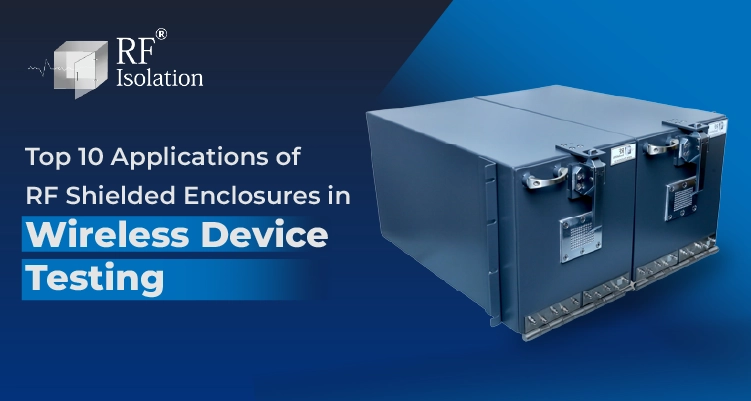
An RF shielded enclosure is a specialized container, box, or room designed to block electromagnetic interference (EMI) and radio frequency (RF) signals.
Think of it as a soundproof room, but for radio waves.
Its job is to isolate the device being tested (known as the Device Under Test, or DUT) from the outside world. This creates a perfect, signal-silent environment, ensuring that the only signals being measured are the ones you want to measure.
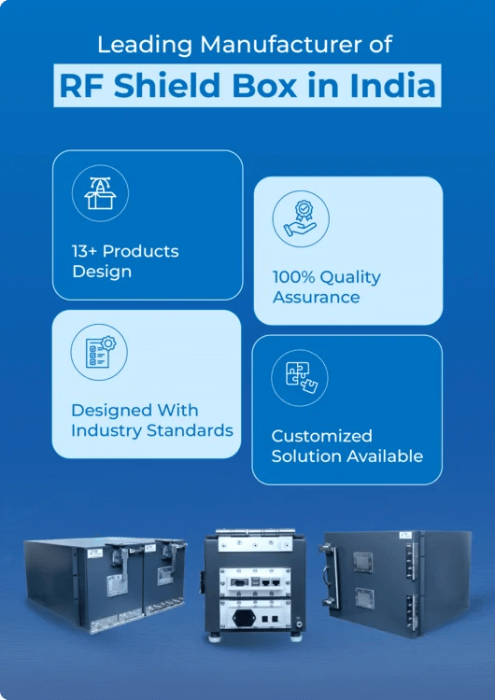
These enclosures can range from small RF Desktop Shield Boxes for testing mobile phones to large, walk-in RF Shielded Rooms (or RF Chambers) big enough to test a car or large medical equipment.
Why Is a Controlled RF Environment So Critical for Testing?
A controlled RF environment is the foundation of all accurate wireless testing. Without it, you face two massive problems:
- Signal Contamination (False Negatives): External signals from 5G towers, Wi-Fi routers, or other lab equipment can “leak” into your test setup. This interference can corrupt your measurements, making a perfectly good device appear to fail.
- Signal Leakage (False Positives): The device you are testing can provide signals that interfere with other sensitive equipment in your lab, or worse, violate compliance rules before it’s even ready for market.
Using RF shielding solutions provides a stable, repeatable baseline. It ensures that your test results are accurate and reliable, which is fundamental for R&D, product validation, and achieving electromagnetic compliance (EMC).
Top 10 Applications for RF Shielded Enclosures
Here are the most common and critical use cases for RF isolation in today’s demanding industries, based on key testing requirements.
Device Certification and EMC/EMI Testing
This application ensures devices comply with regulatory standards by isolating them from external electromagnetic interference (EMI). It’s also used for “pre-compliance” testing, allowing engineers to check their own emissions before sending a product to a formal test lab.
A high-quality RF Chamber or RF Shielded Room is critical for this. It creates a controlled environment to get accurate EMI/EMC measurements, saving companies thousands by catching failures before they become costly certification problems.
Wireless Protocol Testing
This allows for precise testing of specific wireless technologies like Wi-Fi (including new Wi-Fi 6E/7) and Bluetooth without interference from outside signals.
When testing a protocol’s performance, range, and data throughput, you can’t have the lab’s Wi-Fi network or a co-worker’s Bluetooth headset corrupting the results. A Desktop RF Shield Box provides a simple, benchtop solution for isolating these devices.
Antenna Performance Evaluation
This is essential for testing antenna performance by providing a clean, controlled environment. It allows engineers to accurately measure critical parameters like radiation patterns, gain, and efficiency.
An antenna’s true performance can only be measured in a signal-free space. RF test enclosures create this “anechoic” or reflection-less environment, ensuring that measurements reflect the antenna design, not its surroundings.
5G and Next-Gen Technology Testing
This is crucial for testing high-frequency technologies like mmWave (millimeter wave) and Massive MIMO. These technologies require ultra-high isolation to measure performance accurately.
The frequencies used in 5G and 6G device testing are highly sensitive to interference and blockage. A high-performance RF test enclosure is non-negotiable for validating modulation, data rates, and signal integrity.
IoT and Smart Home Device Evaluation
This enables the testing of the large number of connected devices in the Internet of Things (IoT) and smart home sectors, where interference is common.
A smart home may have dozens of devices (lights, speakers, locks) all “talking” at once. RF enclosures are used to test for “coexistence”- ensuring your new smart thermostat doesn’t fail when someone streams music to a nearby Bluetooth speaker.
Automotive and Aerospace Communication Testing
This is used to test in-vehicle communication systems (like V2X, GPS, and radar) and avionics/radar systems in a controlled environment. The goal is to ensure they function reliably and don’t interfere with other critical systems.
In a car or an aircraft, signal failure is not an option. Large RF Chambers (or walk-in RF Shielded Rooms) are used to test these complex systems against interference, ensuring navigation and safety communications are always reliable.
Medical Device Safety Testing
This provides a shielded environment for testing medical devices like pacemakers and MRI machines. It ensures they operate safely and reliably without being affected by external RF interference.
This is a life-critical application. You must guarantee that a stray signal from a hospital’s Wi-Fi or a patient’s mobile phone cannot interfere with a life-sustaining device. RF shielding solutions are essential for immunity testing.
Secure Communication Testing
This creates a secure, isolated space for testing defense and surveillance equipment. It ensures that data security and signal integrity are maintained during the testing process.
For military and defense applications, this has two purposes: first, to test immunity (jamming resistance), and second, to prevent highly sensitive signals from being intercepted (e-D) during R&D.
Cellular and Mobile Phone Performance Analysis
This allows for the evaluation of signal strength, call quality, and data transfer rates for smartphones under controlled conditions before they are released to the public.
To test a phone’s “reception,” you can’t depend on the local cell tower. Instead, you place the phone in a Standalone RF Shield Box and use a signal generator to simulate a network, allowing for repeatable tests of its performance from “full bars” to a weak signal.
Research and Development (R&D)
This provides a fundamental tool for engineers to debug new wireless products and test their performance, reliability, and functionality across different stages of development.
Whether designing a new antenna, a new chip, or a new type of sensor, R&D labs need a stable, known baseline. RF Test Racks and Desktop Boxes are workhorses in R&D, giving engineers a “clean” space to innovate and solve problems quickly.
How Do I Choose the Right RF Shielded Enclosure?
Choosing the right RF shielding solution isn’t one-size-fits-all. It depends entirely on your application.
Here are the key questions an engineer or procurement manager should ask:
- What is the Frequency Range?
Do you need to block low-frequency radio, or high-frequency 5G mmWave signals? The enclosure must be rated for your specific frequencies.
- What Shielding Effectiveness (Attenuation) is Needed?
How “quiet” does it need to be? An 80 dB enclosure is good for simple tests, but 100 dB or more might be needed for high-sensitivity or secure tests.
- What Size and Form Factor?
Do you need a small Desktop Box for a single phone, a Rack Mount solution for 20 devices, or a walk-in RF Shielded Room for large equipment?
- What I/O Ports are Required?
How will you power and control the device? You’ll need an I/O panel with filtered connections for USB, Ethernet, DC power, SMA (for RF signals), or fiber optics that won’t let RF signals leak.
Your Partner for a Controlled RF Testing Environment
In the end, accurate and reliable wireless device testing is non-negotiable. You can’t design the products of the future on a foundation of guesswork.
The only way to ensure your data is clean, your tests are repeatable, and your product is compliant is by using a high-quality, purpose-built RF test enclosure.
At RFIsolation, we specialize in engineering these controlled environments. From standard RF Standalone Shield Boxes to fully custom, RF Shielded Rooms, our team understands the challenges you face.
Don’t let signal interference compromise your innovation.
- Explore our full range of RF test enclosures and shielded rooms on our website.
- Have a unique challenge? Contact our engineering team today for a consultation to design the perfect RF shielding solution for your specific application.
Frequently Asked Questions (FAQ)
An RF shielded box is a compact enclosure designed to sit on a bench or in a rack for testing small-to-medium-sized devices. An RF shielded room is a large, walk-in structure designed to test large equipment or to allow engineers to work inside the equipment.
Attenuation measures the enclosure’s ability to reduce or “weaken” an RF signal. It’s measured in decibels (dB). A higher dB rating means better shielding. For example, an enclosure with -90 dB attenuation reduces an outside signal to one-billionth of its original strength, effectively creating a “silent” zone inside.
Yes. This is a common need for production lines and test labs. A Rack Mount RF Shield Box or a modular RF Test Rack is designed for this. It integrates multiple, individually shielded enclosures into a single, space-saving cabinet, allowing you to run many tests in parallel without interference.
You use specialized, filtered I/O (Input/Output) panels. These panels are built into the enclosure wall and provide standard connections like USB, Ethernet, SMA (coaxial), AC/DC power, and fiber optic ports. These filters are critical because they allow data and power to pass through while stripping away and blocking any unwanted RF signals from “leaking” in or out.
The terms are often used together. EMI (Electromagnetic Interference) is a broad term for any electromagnetic disturbance that disrupts an electronic device. RFI (Radio Frequency Interference) is a specific type of EMI that occurs within the radio frequency spectrum. All RF shielded enclosures are designed to protect against both.